
Schering-Plough
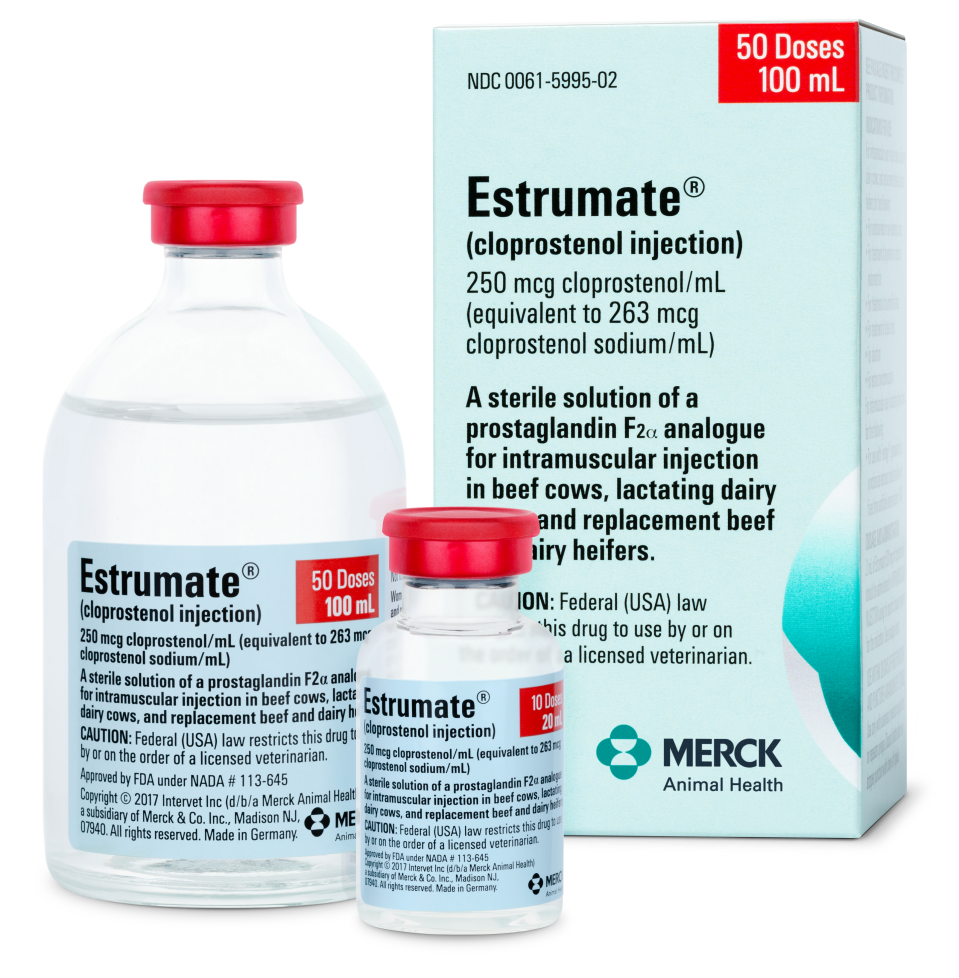
(cloprostenol sodium)
Prostaglandin Analogue for Cattle
Equivalent to 250 mcg cloprostenol/mL
Estrumate® (cloprostenol sodium) is a synthetic prostaglandin analogue structureally related to prostaglandin F2α(PGF2α). Each mL of the colorless aqueous solution contains 263 mcg of cloprostenol sodium (equivalent to 250 mcg of cloprostenol) in a sodium citrate, anhydrous citric acid and sodium chloride buffer containing 0.1% w/v chlorocresol BP as a bactericide. pH is adjusted, as necessary, with sodium hydroxide or citric acid.

ACTION:
Estrumate causes functional and morphological regression of the corpus luteum (luteolysis) in cattle. In normal, nonpregnant cycling animals, this effect on the life span of the corpus luteum usually results in estrus 2 to 5 days after treatment. In animals with prolonged luteal function (pyometra, mummified fetus, and luteal cysts), the induced luteolysis usually results in resolution of the condition and return to cyclicity. Pregnant animals may abort depending on the stage of gestation.
INDICATIONS:
For intramuscular use to induce luteolysis in beef and dairy cattle. The luteolytic action of Estrumate can be utilized to manipulate the estrous cycle to better fit certain management practices, to terminate pregnancies resulting from mismatings, and to treat certain conditions associated with prolonged luteal function.
RECOMMENDED USES:
Unobserved or nondetected estrus
Cows which are not detected in estrus, although ovarian cyclicity continues, can be treated with Estrumate if a mature corpus luteum is present. Estrus is expected to occur 2 to 5 days following injection, at which time animals may be inseminated. Treated cattle should be inseminated at the usual time following detection of estrus. If estrous detection is not desirable or possible, treated animals may be inseminated twice at about 72 and 96 hours postinjection.
Pyometra or Chronic Endometritis
Damage to the reproductive tract at calving or postpartum retention of the placenta often leads to infection and inflammation of the uterus (endometritis). Under certain circumstances, this may progress into chronic endometritis with the uterus becoming distended with purulent matter. This condition, commonly referred to as pyometra, is characterized by a lack of cyclical estrous behavior and the presence of a persistent corpus luteum. Induction of luteolysis with Estrumate usually results in evacuation of the uterus and a return to normal cyclical activity within 14 days after treatment. After 14 days posttreatment, recovery rate of treated animals will not be different than that of untreated cattle.
Mummified Fetus
Death of the conceptus during gestation may be followed by its degeneration and dehydration. Induction of luteolysis with Estrumate usually results in expulsion of the mummified fetus from the uterus. (Manual assistance may be necessary to remove the fetus from the vagina.) Normal cyclical activity usually follows.
Luteal Cysts
A cow may be noncyclic due to the presence of a luteal cyst (a single, anovulatory follicle with a thickened wall which is accompanied by no external signs and by no changes in palpable consistency of the uterus). Treatment with Estrumate can restore normal ovarian activity by causing regression of the luteal cyst.
Pregnancies from Mismating
Unwanted pregnancies can be safely and efficiently terminated from 1 week after mating until about 5 months of gestation. The induced abortion is normally uncomplicated and the fetus and placenta are usually expelled about 4 to 5 days after the injection with the reproductive tract returning to normal soon after the abortion. The ability of Estrumate to induce abortion decreases beyond the fifth month of gestation while the risk of dystocia and its consequences increases. Estrumate has not been sufficiently tested under feedlot conditions; therefore, recommendations cannot be made for its use in heifers placed in feedlots.
Controlled Breeding
The luteolytic action of Estrumate can be utilized to schedule estrus and ovulation for an individual cycling animal or a group of animals. This allows control of the time at which cycling cows or heifers can be bred. Estrumate can be incorporated into a controlled breeding program by the following methods:
REQUIREMENTS FOR CONTROLLED BREEDING PROGRAMS:
A variety of programs can be designed to best meet the needs of individual management systems. A controlled breeding program should be selected which is appropriate for the existing circumstances and management practices.
Before a controlled breeding program is planned, the producer's objectives must be examined and he must be made aware of the projected results and limitations. The producer and his consulting veterinarian should review the operation's breeding history, herd health, and nutritional status and agree that a controlled breeding program is practical in the producer's specific situation. For any successful controlled breeding program: cows and heifers must be normal, nonpregnant, and cycling (rectal palpation should be performed); cattle must be in a fit and thrifty breeding condition and on an adequate or increasing plane of nutrition; proper program planning and record keeping are essential; if artificial insemination is used, it must be performed by competent inseminators using high-quality semen.
It is important to understand that Estrumate is effective only in animals with a mature corpus luteum (ovulation must have occurred at least 5 days prior to treatment). This must be considered when breeding is intended following a single Estrumate injection.
SAFETY AND TOXICITY:
At 50 and 100 times the recommended dose, mild side effects may be detected in some cattle. These include increased uneasiness, slight frothing, and milk let-down.
CONTRAINDICATIONS:
Estrumate should not be administered to a pregnant animal whose calf is not to be aborted.
PRECAUTIONS:
There is no effect on fertility following the single or double dosage regimen when breeding occurs at induced estrus or at 72 and 96 hours posttreatment. Conception rates may be lower than expected in those fixed time breeding programs which omit the second insemination (ie, the insemination at or near 96 hours). This is especially true if a fixed time insemination is used following a single Estrumate injection. As with all parenteral products, careful aseptic techniques should be employed to decrease the possibility of postinjection bacterial infection. Antibiotic therapy should be employed at the first sign of infection.
DOSAGE AND ADMINISTRATION:
Two mL of Estrumate (500 mcg of cloprostenol) should be administered by INTRAMUSCULAR INJECTION for all indications in both beef and dairy cattle.
WARNINGS
For veterinary use only.
Women of childbearing age, asthmatics, and persons with bronchial and other respiratory problems should exercise extreme caution when handling this product. In the early stages, women may be unaware of their pregnancies. Estrumate is readily absorbed through the skin and may cause abortion and/or bronchospasms; direct contact with the skin should therefore be avoided. Accidental spillage on the skin should be washed off immediately with soap and water.
STORAGE CONDITIONS:
HOW SUPPLIED:
20-mL multidose vials
CAUTION:
Federal (USA) law restricts this drug to use by or on the order of a licensed veterinarian.
NADA 113-645, Approved by FDA
Made in Germany.
Copyright © 1999, Schering-Plough Animal Health Corp., Union NJ 07083.
All rights reserved.
25089405 Rev. 3/01
USA030396INR, USA030396INV
US 3398
NAC No.: 10470671